
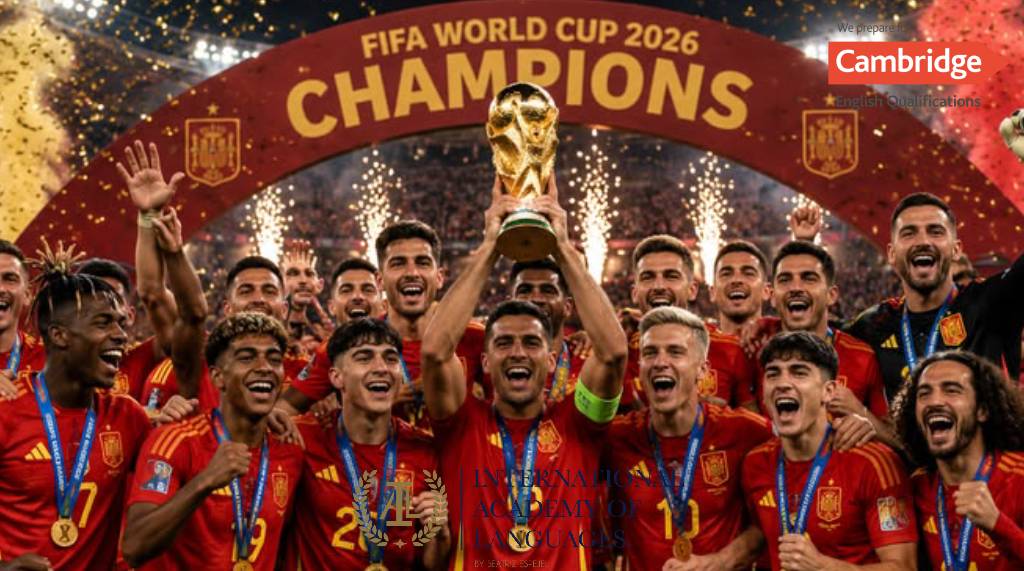
Some victories remain in a nation’s memory forever, and Spain’s success at the 2026 FIFA World Cup is undoubtedly one of them.
Sixteen years after lifting the World Cup trophy in South Africa, Spain has once again been crowned world champion after defeating Argentina 1–0 in extra time thanks to a goal from Ferran Torres in the 106th minute. It was an intense final played at the New York New Jersey Stadium, bringing the biggest World Cup in history to a spectacular close. It was also the first tournament ever to be co-hosted by three countries: the United States, Canada and Mexico.
La Roja’s victory made headlines in some of the world’s most influential media outlets. What makes their coverage particularly interesting is that many journalists went beyond simply reporting the result. They analysed Spain’s style of play, its tactical maturity and the historical significance of this achievement.
Before looking at the international headlines, it is worth remembering how Spain reached the top.
Luis de la Fuente’s side enjoyed an outstanding tournament. They defeated Austria in the Round of 16, overcame Belgium in the quarter-finals and knocked out France in the semi-finals with another convincing performance. Waiting in the final was Argentina, the 2022 World Cup champion led by Lionel Messi.
Spain controlled large portions of the match, enjoyed more possession and created the clearest chances. Just when the game seemed destined for a penalty shootout, Ferran Torres found the net to send La Roja back to the summit of world football.
The Washington Post: “Not even Lionel Messi had any answers”
One of the most talked-about headlines came from the United States.
In a report by the Associated Press, The Washington Post summed up Spain’s dominance with a sentence that quickly went viral:
“This is how good Spain was at the World Cup: Not even Lionel Messi had any answers.”
The article explains how Spain managed to neutralise one of the greatest players in football history. The American press praised the team’s tactical discipline, coordinated pressing and ability to control the key moments of the match.
It also highlighted that Ferran Torres scored “the goal of his life”, a common expression in sports journalism used to describe the most important goal of a player’s career.
“An epic World Cup… with Spain finishing on top”
In another feature, The Washington Post focused on the historic scale of the tournament.
The newspaper published the headline:
“An epic World Cup goes even longer, with Spain finishing on top.”
It also included a reflection on what made this edition of the World Cup so unique:
“A tournament that began as a grand experiment across three countries ended with a finish worthy of all its sprawl.”
Through these words, the American newspaper praised not only Spain’s success but also the organisation of the first World Cup hosted by three different nations. It described the tournament as an ambitious global experiment that concluded with a fittingly memorable final.
FIFA: “Spain, the World Champions Who Controlled Everything”
FIFA itself also paid tribute to Spain’s remarkable campaign.
In its official analysis, the organisation described La Roja as:
“Spain, the world champions who controlled everything.”
FIFA explained that Spain dominated the final from start to finish and highlighted three key strengths throughout the tournament: ball control, defensive solidity and composure under pressure.
The English version of FIFA’s analysis featured the powerful headline:
“Control, composure, champions.”
Just three words perfectly captured Spain’s identity throughout the competition: a team defined by personality, patience and competitive maturity.
There is one idea that appears consistently across almost every international report: admiration for Spain’s style of football.
Many journalists agreed that Spain did not win because of one isolated moment, but because it consistently outperformed its opponents in the biggest matches. The team’s ability to dominate possession, increase the tempo when necessary and defend as a unit became recurring themes throughout the international coverage.
Even in Argentina, many football analysts and former players acknowledged Spain’s superiority, describing La Roja as the tournament’s most complete team and a deserving world champion.
At International Academy of Languages, we like to look beyond the scoreline and focus on another fascinating aspect: the language used by the international press.
When we read expressions such as “finishing on top,” “had no answers,” or “the goal of his life,” we are not studying textbook English. We are learning the authentic language used every day by newspapers, sports commentators and football fans around the world.
For example:
Today we celebrate much more than a historic victory. We celebrate the power of sport to bring people together across cultures, languages and borders.
For weeks, millions of fans from around the world have shared the same passion. In most cases, they have done so by communicating in English. That is why we believe learning a language is far more than a professional skill; it is a way of connecting with different cultures, understanding new perspectives and experiencing global events such as the FIFA World Cup from a much richer point of view.
At International Academy of Languages, we proudly join football fans across Spain in celebrating this incredible achievement.
Hay victorias que se quedan para siempre en la memoria de un país, como la conseguida por la selección española en el Mundial de 2026.
Dieciséis años después de levantar la Copa del Mundo en Sudáfrica, España ha vuelto a proclamarse campeona del mundo tras imponerse a Argentina por 1-0 en la prórroga gracias a un gol de Ferran Torres en el minuto 106. Una final intensa, disputada en el New York New Jersey Stadium, que puso el broche de oro al mayor Mundial de la historia, el primero organizado de forma conjunta por Estados Unidos, Canadá y México.
La victoria de La Roja ha ocupado las portadas de algunos de los medios de comunicación más importantes del mundo. Y lo más interesante es que muchos de ellos no se limitaron a contar el resultado: analizaron el estilo de juego de España, su madurez competitiva y el significado histórico de este título.
Antes de mirar las portadas internacionales, merece la pena recordar cómo llegó España a lo más alto.
La selección de Luis de la Fuente completó un torneo muy sólido. Superó a Austria en octavos, eliminó a Bélgica en cuartos y dejó fuera a Francia en semifinales con una actuación muy convincente. En la final esperaba Argentina, campeona del mundo en 2022 y liderada por Lionel Messi.
España controló gran parte del partido, tuvo más posesión y generó las ocasiones más claras. Cuando todo parecía encaminado a los penaltis, apareció Ferran Torres para marcar el gol que devolvía a La Roja a la cima del fútbol mundial.
The Washington Post: “Not even Lionel Messi had any answers”
Uno de los titulares más comentados llegó desde Estados Unidos.
The Washington Post, a través de la crónica de Associated Press, resumió la superioridad española con una frase que rápidamente se hizo viral:
“This is how good Spain was at the World Cup: Not even Lionel Messi had any answers.”
El artículo desarrolla la idea de que España fue capaz de neutralizar incluso al jugador más determinante de la historia reciente del fútbol. La prensa estadounidense destaca el trabajo táctico del equipo, la presión coordinada y la capacidad para controlar los momentos clave del encuentro.
Además, el periódico subraya que Ferran Torres marcó “the goal of his life”, una expresión muy habitual en el inglés deportivo para referirse al gol más importante de la carrera de un futbolista.
“An epic World Cup… with Spain finishing on top”
En otra de sus crónicas, The Washington Post puso el foco en la dimensión histórica del torneo.
El medio tituló:
“An epic World Cup goes even longer, with Spain finishing on top.”
Y añadía una reflexión muy interesante sobre el carácter excepcional de este Mundial:
“A tournament that began as a grand experiment across three countries ended with a finish worthy of all its sprawl.”
Con estas palabras, la prensa estadounidense no solo elogia a España, sino también el éxito organizativo del primer Mundial celebrado en tres países. El artículo presenta el torneo como un experimento gigantesco que terminó con un desenlace a la altura de su magnitud.
La FIFA: “España, la campeona del mundo que controló todo”
La propia FIFA también quiso rendirse al campeonato realizado por la selección.
En su análisis oficial describió a La Roja como:
“España, la campeona del mundo que controló todo.”
El organismo internacional explica que España dominó la final “de principio a fin” y destaca tres aspectos fundamentales: el control del balón, la solidez defensiva y la serenidad en los momentos de máxima presión.
La versión en inglés del análisis utiliza un titular muy expresivo:
“Control, composure, champions.”
Tres palabras que resumen perfectamente la imagen que ha dejado España en este Mundial: un equipo con personalidad, paciencia y madurez competitiva.
Existe un elemento común en prácticamente todas las crónicas internacionales, el reconocimiento al estilo de juego español.
Muchos medios coinciden en que España no ganó únicamente por un detalle puntual, sino porque fue el equipo que mejor interpretó los partidos importantes. La capacidad para tener el balón, acelerar cuando era necesario y defender con orden ha sido una de las ideas más repetidas en la prensa extranjera.
Incluso desde Argentina llegaron voces reconociendo la superioridad española. Varios analistas y exfutbolistas señalaron que La Roja fue el equipo más completo del torneo y un campeón merecido.
En International Academy of Languages nos gusta fijarnos en otro detalle que a veces pasa desapercibido, el lenguaje que utiliza la prensa internacional.
Cuando leemos titulares como “finishing on top”, “had no answers” o “the goal of his life”, no estamos estudiando un inglés académico de libro de texto, sino el inglés que aparece cada día en periódicos, retransmisiones deportivas y conversaciones entre aficionados.
Por ejemplo:
Desde International Academy of Languages, apoyamos a nuestra selección
Hoy celebramos una victoria histórica, pero también algo más grande, la capacidad del deporte para unir a personas de todo el mundo.
Durante semanas, millones de aficionados de diferentes países han compartido una misma pasión. Y, en la mayoría de los casos, lo han hecho comunicándose en inglés. Por eso creemos que aprender un idioma no es solo una herramienta profesional; es una forma de conectar con otras culturas, entender otras miradas y vivir acontecimientos como un Mundial desde una perspectiva mucho más amplia.
En International Academy of Languages nos unimos a la alegría de todos los aficionados y felicitamos a la selección española por este nuevo título mundial.
¡Enhorabuena, campeones! ⭐⭐
Alba Domínguez Bravo

Si quieres saber cuál es tu nivel de inglés, o no tienes claro por dónde empezar, escríbenos tus datos y te ayudamos: